Exploring Christian Imaginations of the Religious Other: A Scholarly Discussion

Updated: Feb 2
A Gathering of Minds
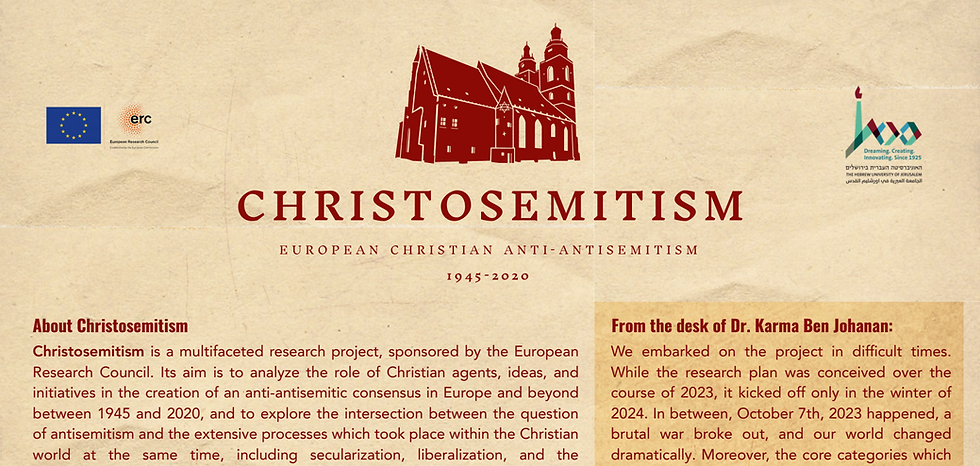
In December, the Christosemitism team convened via Zoom with a distinguished group of scholars, under the leadership of Prof. Gavin D’Costa from The Pontifical University of St. Thomas Aquinas (Angelicum). The primary focus of this gathering was a disucssion of Marianne Moyaert’s seminal work, Christian Imaginations of the Religious Other: A History of Religionization (Hoboken, NJ: Wiley Blackwell, 2024). This book serves as a critical exploration of the intricate relationship between Christianity and the perception of religious others throughout history.
The Significance of Moyaert's Work
Moyaert's text delves into the historical processes by which Christianity has constructed its narratives surrounding other religions. This examination is particularly relevant in the context of post-1945 Western Europe, where the dynamics of religious identity and interfaith relations have undergone significant transformations. The book not only provides an historical account but also engages with contemporary debates surrounding religious pluralism and the implications of these narratives for current societal challenges.
Key Themes and Discussions
During the Zoom meeting, participants engaged in a robust dialogue regarding several key themes presented in Moyaert's work. One prominent theme is the concept of "religionization," which refers to the processes through which religious identities are formed, negotiated, and contested. This concept is critical for understanding how religious narratives shape societal perceptions and, consequently, influence inter-religious relations.
Moreover, the scholars discussed the implications of Moyaert's findings for the ongoing fight against antisemitism. The Christosemitism project aims to significantly advance academic understanding of how Christianity has shaped the fight against antisemitism in post-1945 Western Europe, highlighting the often-overlooked religious dimensions in these complex debates. This intersection of history, religion, and sociology is essential for comprehending the nuanced ways in which religious narratives can perpetuate or challenge societal prejudices.
The Role of Academic Discourse
The dialogue facilitated by Prof. D’Costa and the Christosemitism team underscores the importance of academic discourse in addressing pressing social issues. The insights gained from this dialogue not only enrich the academic discourse but also contribute to a broader understanding of the religious dimensions that shape interfaith relations in contemporary society. As we continue to explore these themes, it is imperative to recognize the significance of historical narratives in informing our present and future interactions with diverse religious identities.